

The pods design guide
Your good idea is the source of my creation
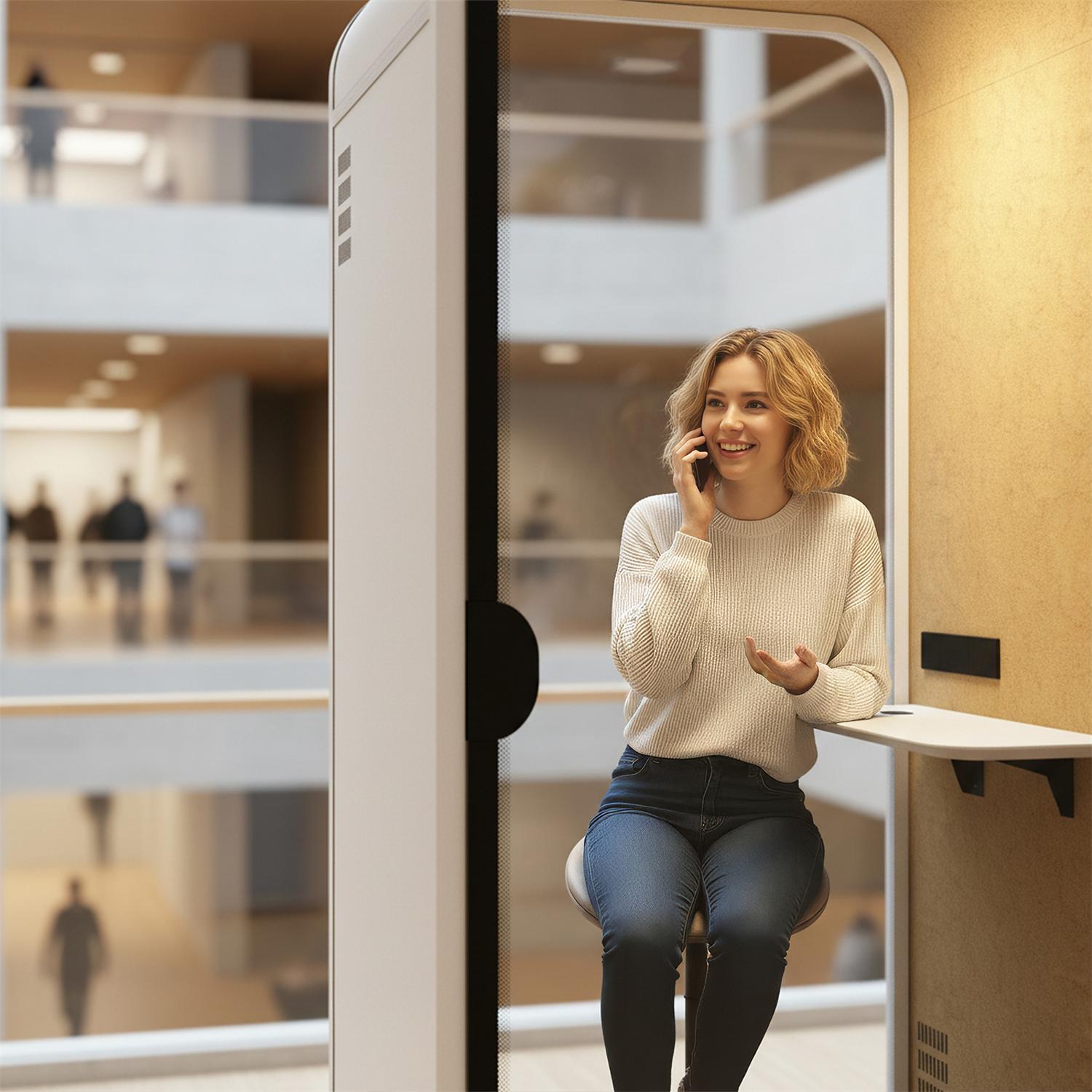
The pods design guide
Your good idea is the source of my creation
Install acoustic treatment devices such as sound-absorbing panels and soft furniture to reduce echoes and reverberations.
Utilize acoustic sensors to monitor and manage background noise.
• Use partition, layout changes, and KL soundproof cabin solutions for noise control design.
Space design, materials, and noise sources
Hard surfaces such as glass and concrete reflect sound, increasing echo and reverberation.
An open layout without partitions allows sound to propagate freely, making it more difficult to focus.
The air conditioning system, office equipment, and conversations will generate continuous background noise.
Soundproofing wall panels and ceiling baffles absorb mid to high frequency sounds
Carpets, curtains, and upholstered furniture help control footsteps and impact noise.
The fabric covered surface and soft partitions enhance the acoustic comfort of the shared space.
• Use partitioning strategies to separate quiet office areas from social areas
Choose materials that absorb and diffuse sound, especially in high usage areas.
Intelligent acoustic design ensures compatibility between different work styles and rejects singularity
*Used for enclosed spaces, learning, meetings, quiet areas in public places, etc
Choose the ADDE team to provide you with professional solutions.
ISO 22955 and ISO 3382-3 recommend environmental noise levels between 35-45dB (A)
The reverberation time (RT60) is 0.6-0.8 seconds
Dispersion distance (rD) below 4.5 meters in open spaces
Please contact the Adde team